

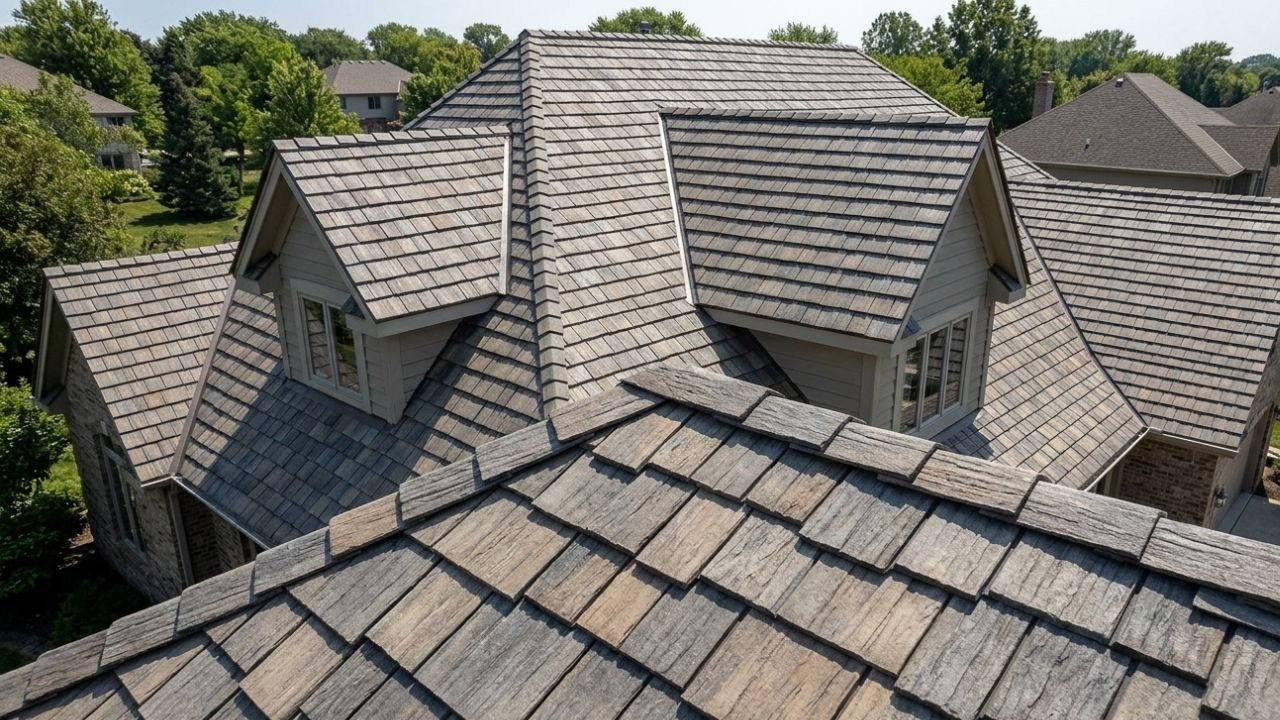
You're shopping for a new roof and the word composite keeps showing up. Your contractor mentions it. You see it on roofing websites. And it sounds appealing — but you're not entirely sure what it actually means or whether it's the right choice for your home.
You're not alone. Composite roofing is one of the fastest growing categories in the residential roofing market right now — but it's also one of the least understood by average homeowners.
Let's fix that.
The Simple Definition
A composite roof is a roofing system made from a blend of synthetic materials — typically a combination of fiberglass, recycled plastics, rubber, and polymer resins — engineered to look like natural roofing materials such as slate, wood shake, or clay tile.
The word composite literally means something made of multiple combined components. In roofing that means taking several materials that each bring something to the table — strength, flexibility, UV resistance, fire resistance — and engineering them together into a single roofing product that outperforms what any one material could do on its own.
The result is a roofing shingle or tile that looks remarkably like premium natural materials but is lighter, more durable, easier to install, and significantly less expensive.
What Are Composite Shingles Made Of?
The exact composition varies by manufacturer and product line. But most composite roofing products are made from some combination of the following:
Fiberglass
Fiberglass provides the structural backbone of most composite shingles. It's lightweight, dimensionally stable, and doesn't rot or absorb moisture. A fiberglass mat or mesh is embedded within the shingle to give it strength and prevent cracking or warping over time.
Recycled Plastics and Rubber
Many composite shingles incorporate recycled plastics — often from post-consumer waste — and recycled rubber. This gives the shingle flexibility and impact resistance. It also makes composite roofing one of the more environmentally friendly roofing options since it diverts waste materials from landfills.
Polymer Resins
Polymer resins bind the materials together and form the outer surface of the shingle. They're engineered for UV stability — meaning they don't fade or degrade quickly under constant sun exposure — and for color retention over decades.
Asphalt
Some composite shingles incorporate asphalt — similar to traditional asphalt shingles — as part of their composition. However composite shingles are significantly more engineered and layered than standard asphalt shingles and shouldn't be confused with them.
Mineral Granules
The surface of composite shingles typically features mineral granules — similar to standard asphalt shingles — that provide texture, additional UV protection, and the visual appearance of natural materials.
What Does a Composite Roof Look Like?
This is one of composite roofing's biggest selling points. Modern composite shingles are extraordinarily realistic in their appearance.
Composite Slate
This is the most popular style. Composite slate shingles mimic the look of natural quarried slate — the irregular edges, the layered texture, the subtle color variation from tile to tile. From the street or even up close, it can be genuinely difficult to distinguish from real slate.
Natural slate is one of the most beautiful roofing materials in existence. It's also incredibly heavy, expensive, and requires specialized installation expertise. Composite slate delivers virtually the same visual appeal at a fraction of the cost and weight.
Composite Wood Shake
These shingles replicate the look of hand-split cedar or redwood shake — the rough texture, the natural grain, the organic variation in appearance. They give a home a warm, rustic, natural look without the fire risk, maintenance demands, or environmental concerns associated with real wood shake.
Composite Clay or Spanish Tile
Some composite products mimic the curved profile of clay or Spanish tile — popular in Mediterranean, Mission, and Southwest architectural styles. They deliver the distinctive look without the enormous weight that real clay tile puts on a roof structure.
Composite Slate and Stone Blends
Some premium products blend the appearance of multiple natural materials — creating unique looks that don't directly copy any single natural material but feel organic and premium.
The advancement in manufacturing technology — particularly in mold-making and color application — means today's composite shingles have texture, depth, and color variation that earlier products simply couldn't achieve.
Composite Roofing vs. Standard Asphalt Shingles
A lot of people ask — isn't composite roofing just a fancy asphalt shingle? The answer is no — and the differences are significant.
Feature | Composite Roofing | Standard Asphalt Shingles |
|---|---|---|
Materials | Engineered polymer blend | Asphalt and fiberglass mat |
Appearance | Slate, wood shake, tile | Flat tab or architectural |
Lifespan | 40 – 50+ years | 20 – 30 years |
Weight | Light to moderate | Light |
Impact resistance | Class 4 (highest) | Class 1 – 3 |
Fire rating | Class A | Class A |
Cost | $400 – $900 per sq | $100 – $250 per sq |
Eco-friendly | Often recycled content | Limited recycled content |
Maintenance | Very low | Low |
Standard asphalt shingles are the most installed roofing product in America because of their low cost and adequate performance. Composite shingles cost more upfront but deliver significantly better longevity, impact resistance, and visual appeal.
Over the full lifespan of the roof, composite often costs less than replacing asphalt shingles twice.
Composite Roofing vs. Natural Slate
Natural slate is beautiful and can last over 100 years. But it comes with serious challenges that make composite slate an appealing alternative for most homeowners.
Feature | Composite Slate | Natural Slate |
|---|---|---|
Appearance | Very realistic imitation | Authentic natural look |
Weight | 150 – 250 lbs per square | 800 – 1,500 lbs per square |
Lifespan | 40 – 50+ years | 75 – 150+ years |
Cost installed | $400 – $900 per sq | $1,000 – $4,000 per sq |
Structural requirements | Standard framing | Reinforced framing required |
Installation expertise | Standard roofer | Slate specialist required |
Fragility | Impact resistant | Brittle — can crack |
Repairability | Easy | Difficult — matching hard |
The weight difference is enormous and important. Natural slate is so heavy that many homes require structural reinforcement before it can be installed. Composite slate is light enough for standard roof framing without any modifications.
The cost difference is equally dramatic. Natural slate installation can run three to five times the cost of composite slate — and repairs are difficult and expensive because matching original slate is challenging.
For the vast majority of homeowners who want the look of slate, composite is the more practical and financially sensible choice.
Composite Roofing vs. Wood Shake
Real wood shake has a beautiful, natural look that many homeowners love. But it comes with significant drawbacks that have driven many people toward composite alternatives.
Feature | Composite Shake | Real Wood Shake |
|---|---|---|
Appearance | Very realistic | Authentic natural |
Fire resistance | Class A rated | Poor — fire hazard |
Maintenance | Very low | High — regular treatment needed |
Rot and mold | Resistant | Susceptible |
Lifespan | 40 – 50 years | 20 – 30 years |
Cost | Moderate to high | Moderate to high |
Insurance impact | Neutral or positive | Can raise premiums |
Environmental | Recycled materials | Old growth timber concerns |
Real wood shake requires regular cleaning, treatment, and inspection to prevent rot, mold, and moss growth. It's also a fire hazard — many insurance companies charge higher premiums for homes with wood shake roofs. Some municipalities in fire-prone areas have actually banned new wood shake installations.
Composite shake eliminates every one of these problems while delivering a nearly identical appearance.
The Benefits of Composite Roofing
Exceptional Durability and Longevity
Most premium composite shingles are rated for 40 to 50 years — with some manufacturers offering lifetime warranties. That's significantly longer than standard asphalt shingles which typically last 20 to 30 years.
The engineered polymer construction resists the things that degrade other roofing materials — UV radiation, moisture, freeze-thaw cycles, impact, and biological growth.
Impact Resistance
This is one of composite roofing's most impressive specifications. Most premium composite shingles achieve a Class 4 impact resistance rating — the highest possible rating under UL 2218 testing standards.
Class 4 impact resistance means the shingle can withstand the impact of a 2-inch steel ball dropped from 20 feet without cracking or fracturing. In real-world terms it means composite shingles hold up exceptionally well against hail — one of the most common causes of roof damage in the United States.
In many states homeowners with Class 4 impact-rated roofing receive discounts on homeowner's insurance premiums — sometimes 20% to 30% off the roof portion of their coverage. Over time those savings can offset a significant portion of the higher upfront cost.
Lightweight
Despite their premium look and durability composite shingles are surprisingly light. Most products weigh between 150 and 300 pounds per square (100 square feet) — comparable to standard asphalt shingles and dramatically lighter than natural slate or clay tile.
This means composite roofing can be installed on virtually any standard roof structure without reinforcement.
Low Maintenance
Composite shingles don't rot. They don't absorb moisture. They resist algae and moss growth. They don't crack in cold weather or warp in heat.
The maintenance requirements are minimal — an occasional inspection and cleaning are really all that's needed. No annual treatments, no sealing, no re-staining. This is a significant advantage over wood shake and even natural slate.
Fire Resistance
Most composite shingles carry a Class A fire rating — the highest level of fire resistance for roofing materials. This is the same rating as metal roofing and clay tile and significantly better than wood shake.
Class A means the material is effective against severe fire exposure. For homeowners in wildfire-prone areas this is a critical consideration — and can directly affect insurance rates.
Environmentally Friendly
Many composite shingles are made from recycled materials — post-consumer plastics, reclaimed rubber, and industrial byproducts. Using these materials reduces landfill waste and lowers the environmental impact of the roofing product.
At end of life, composite shingles are also recyclable — unlike asphalt shingles which represent a significant portion of construction waste in landfills across the country.
Color Retention
Premium composite shingles use through-body color technology — meaning the color goes all the way through the shingle rather than just being a surface coating. This means even if the surface weathers slightly, the color remains consistent. Most manufacturers guarantee color retention for the life of the warranty.
The Drawbacks of Composite Roofing
Every roofing material has tradeoffs. Here's an honest look at composite roofing's limitations:
Higher Upfront Cost
This is the biggest barrier for most homeowners. Composite roofing costs significantly more than standard asphalt shingles. On a typical home the difference might be $5,000 to $15,000 more than an asphalt shingle roof.
The counterargument — which is valid — is that composite roofing lasts twice as long as asphalt shingles. So while you pay more upfront, you may never need to replace the roof again. Over 50 years the total cost of two asphalt roofs often exceeds the cost of one composite roof.
Newer Product Category
Composite roofing has been commercially available since the 1990s but has only reached mainstream adoption in the last 10 to 15 years. This means the very long-term performance data — what happens at year 40 or 50 — is still being established.
Most products are backed by strong manufacturer warranties but the real-world proof of those claims is still accumulating.
Not Identical to Natural Materials
Close — very close — but not identical. If you stand at the edge of a composite slate roof and compare it directly to a natural slate roof, an experienced eye will notice differences. The visual gap has narrowed dramatically in recent years but it's still there for those who care deeply about authenticity.
For most people the difference is negligible from normal viewing distances. But for restoration projects on historic homes where authenticity is essential, natural materials may still be preferable.
Contractor Familiarity
Composite roofing requires slightly different installation techniques than standard asphalt shingles. Not every roofing contractor is experienced with every composite product. Choosing an inexperienced installer can compromise the performance and warranty of the roof.
Always verify that the contractor you choose has specific experience with the composite product you're installing.
How Much Does a Composite Roof Cost?
Composite roofing sits in the premium price range. Here's what to expect across the three major markets:
Project Size | USA (USD) | UK (GBP) | Canada (CAD) |
|---|---|---|---|
Materials only (per square / m²) | $400 – $900 per sq | £40 – £120 per m² | $500 – $1,100 per sq |
Installed cost (per square / m²) | $700 – $1,500 per sq | £80 – £200 per m² | $900 – $1,800 per sq |
Small home (1,000 – 1,500 sq ft) | $10,000 – $18,000 | £8,000 – £20,000 | $12,000 – $22,000 |
Average home (1,500 – 2,000 sq ft) | $12,000 – $25,000 | £12,000 – £30,000 | $15,000 – $30,000 |
Large home (2,500+ sq ft) | $20,000 – $45,000+ | £20,000 – £50,000+ | $25,000 – $55,000+ |
A few things worth keeping in mind across all three markets — prices vary by region, roof complexity, pitch, and the specific composite brand chosen. Urban areas consistently run higher than rural ones. Premium brands like DaVinci Roofscapes, Brava Roof Tile, and CertainTeed Belmont sit at the higher end of the range in the US and Canada. In the UK, Marley Eternit and Tapco SlateBoard are among the well-regarded premium options.
Always get at least three quotes from contractors experienced specifically with composite roofing — prices can vary significantly between companies for the exact same product and roof size.
How Long Does a Composite Roof Last?
This is where composite roofing really distinguishes itself from the competition:
Product Tier | Expected Lifespan | Typical Warranty |
|---|---|---|
Entry-level composite | 25 – 35 years | 30 years |
Mid-range composite | 35 – 50 years | 40 – 50 years |
Premium composite | 50+ years | Lifetime |
Most premium composite products come with lifetime limited warranties — covering the product against manufacturing defects for as long as you own the home. Some warranties are even transferable to a new owner — which can be a selling point if you decide to sell.
Compare this to standard asphalt shingles at 20 to 30 years and the longevity advantage of composite becomes clear.
Top Composite Roofing Brands
If you're shopping for composite roofing here are some of the most respected manufacturers in the market:
DaVinci Roofscapes — Premium composite slate and shake products. Widely considered one of the best in the industry for realism and quality. Made in the USA from recycled materials.
Brava Roof Tile — Composite slate, shake, and Spanish tile products. Strong sustainability focus — made from 100% recycled materials. Class 4 impact and Class A fire rated.
CertainTeed Belmont — From one of North America's largest roofing manufacturers. Composite slate with strong warranty and wide contractor network.
Enviroshake — Canadian manufacturer making composite shake products from recycled materials. Popular in Canada and the northern US.
Euroshield — Another Canadian company making composite roofing from recycled rubber. Unique texture and strong cold-weather performance.
F-Wave — Newer entrant with synthetic shingles engineered for extreme weather performance. Class 4 impact rated with excellent warranty terms.
Is Composite Roofing Worth the Investment?
For most homeowners who can manage the higher upfront cost — yes, absolutely.
Here's the simple math. A standard asphalt shingle roof on a medium-sized home costs roughly $8,000 to $15,000 installed and lasts 20 to 25 years. A composite roof on the same home costs $15,000 to $25,000 but lasts 40 to 50 years.
Over 50 years you'd replace the asphalt roof twice — spending $16,000 to $30,000 total. The composite roof costs more upfront but potentially never needs replacing in your lifetime.
Add in the insurance savings from Class 4 impact rating, the reduced maintenance costs, and the added curb appeal — and the financial case for composite roofing gets even stronger.
It's also worth considering resale value. A premium composite roof is a compelling selling point when listing a home. Buyers who understand roofing recognize its value and it can contribute meaningfully to the perceived quality of the property.
What to Ask Your Contractor Before Choosing Composite Roofing
Before committing to a composite roof here are the key questions to ask:
What brand and product are you recommending? Not all composite shingles are equal. Get the specific product name and look up the specifications and warranty yourself.
What impact and fire ratings does it carry? Make sure it's Class 4 impact and Class A fire rated for maximum performance and insurance benefits.
What does the warranty cover? Understand the difference between a material warranty and an installation warranty. Both matter.
How many composite roofs have you installed? Experience with the specific product matters. Ask to see photos of previous installations.
Is the warranty transferable? If you might sell the home, a transferable warranty adds real value.
Does my insurance company offer a discount for Class 4 rated roofing? Call your insurance agent before finalizing your decision. The answer might significantly affect your cost-benefit analysis.
Bottom Line
A composite roof is a premium synthetic roofing product engineered from a blend of fiberglass, recycled plastics, rubber, and polymer resins to replicate the beauty of natural slate, wood shake, or clay tile — with better durability, lighter weight, and lower maintenance than the real thing.
It costs more upfront than standard asphalt shingles. But it lasts twice as long, handles hail and weather significantly better, carries the highest fire and impact ratings, and delivers a level of curb appeal that basic shingles simply can't match.
If you're planning to stay in your home for the long term, care about how your roof looks, and want a roofing solution that truly lasts — composite roofing deserves serious consideration.
It's one of those home investments where paying more now genuinely means paying less later.
![How Much to Paint a 2000 Square Foot House Interior? [2026 Complete Cost Guide] — Roof on BuildWise Journal](https://core.civopilot.com/storage/posts/p5dzkVu66DnWQA43WfNajYTdhBWBliwksFDE7S7b.webp)