

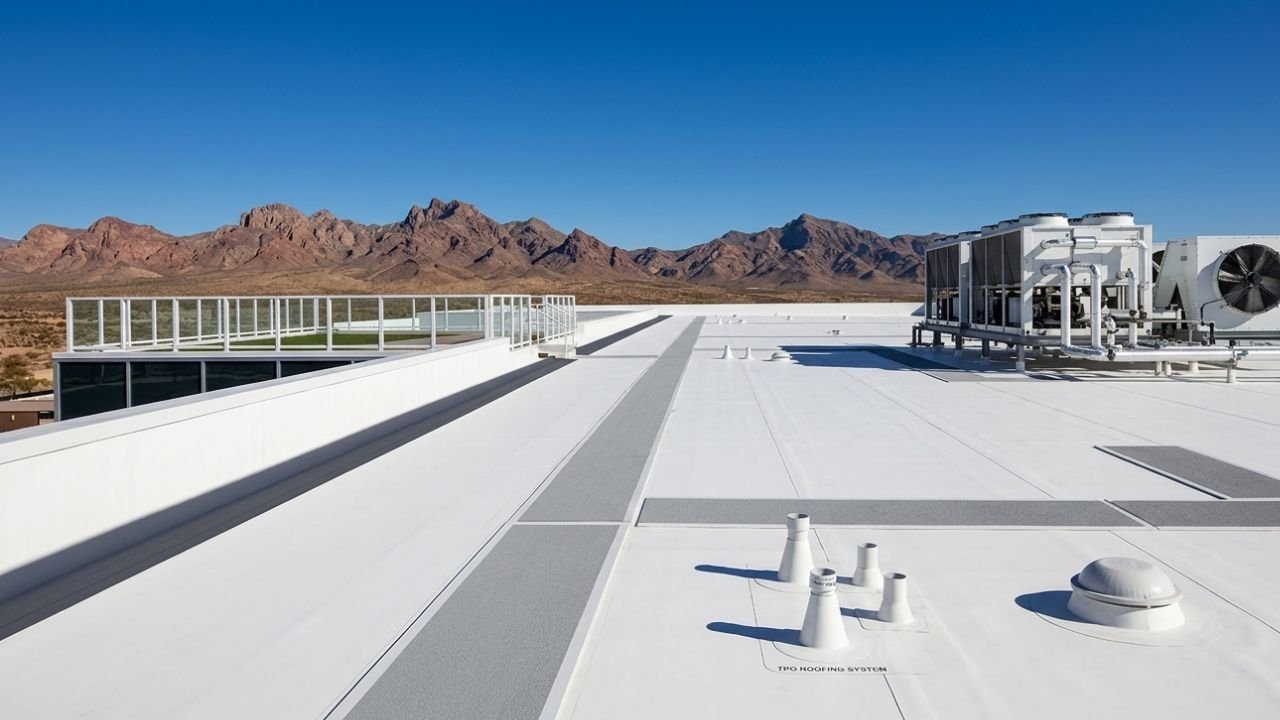
You're getting quotes for a flat or low-slope roof and every contractor keeps throwing around the term TPO. Maybe they're recommending it. Maybe they're comparing it to something else. Either way you're nodding along while quietly wondering — what does TPO actually stand for and what even is it?
No shame in that. Most homeowners have never heard of TPO until they need a flat roof.
Let's break it all down from the beginning.
What Does TPO Stand For?
TPO stands for Thermoplastic Polyolefin.
That's a mouthful. But once you understand what each word means, the material starts to make a lot more sense.
Thermoplastic — means the material can be heated and reshaped without losing its properties. This is critical for how TPO is installed — the seams are literally welded together using hot air, creating watertight bonds that are actually stronger than the membrane itself.
Polyolefin — refers to the family of polymers the material is made from. Polyolefins are a group of lightweight, flexible, and chemically resistant plastics. Polypropylene and polyethylene are two common polyolefins you've probably heard of. TPO combines these polymers with rubber compounds to create a roofing membrane that is both flexible and durable.
Put it together and you get a single-ply roofing membrane that can be heat-welded, is resistant to UV radiation, and holds up well against chemicals, punctures, and extreme weather.
What Is TPO Roofing?
TPO roofing is a type of single-ply roofing membrane — meaning it's a single layer of synthetic material that gets rolled out and installed across a flat or low-slope roof surface.
It comes in large rolls — typically 10, 12, or 20 feet wide — and is installed in overlapping sheets that are heat-welded together at the seams. The result is a continuous, watertight surface across the entire roof.
TPO is almost always white or light gray in color — though other colors are available. That bright white surface is one of TPO's most talked-about features because of how much it reflects sunlight and reduces cooling costs.
It's installed on top of insulation boards which sit on the roof deck — giving the roof system both waterproofing and thermal performance.
How Long Has TPO Been Around?
TPO roofing is actually a relatively young product in the roofing world.
It was introduced to the commercial roofing market in the early 1990s as an alternative to the two dominant single-ply membranes at the time — EPDM (rubber roofing) and PVC (vinyl roofing).
The idea was to combine the best qualities of both — the affordability and flexibility of EPDM with the heat-weldable seams and chemical resistance of PVC — into one product.
It caught on fast. By the 2000s TPO had become one of the most widely installed commercial roofing systems in North America. Today it's the most popular single-ply roofing membrane in the United States by installation volume.
That rapid rise also came with some growing pains — early formulations had inconsistent quality and some membranes failed prematurely. The industry learned from those early issues and modern TPO formulations are significantly more reliable and better tested than the products of the 1990s and early 2000s.
What Is TPO Roofing Made Of?
TPO membranes are engineered from several components layered together:
The Top Ply
The surface layer of TPO is a thermoplastic compound — typically a blend of polypropylene and ethylene-propylene rubber. This layer faces the weather and UV radiation every day. It's formulated to resist UV degradation, ozone, chemical exposure, and temperature extremes.
The Reinforcement Scrim
The middle layer is a polyester or fiberglass reinforcement scrim — a mesh-like fabric that gives the membrane its dimensional stability and tear resistance. Without this layer, the membrane would stretch and deform under stress.
The Bottom Ply
The underside of the membrane is another thermoplastic layer that bonds to the insulation or adhesive below. Some TPO products have a fleece backing on the underside for additional strength and easier installation.
The total thickness of the membrane varies — typically 45 mil, 60 mil, or 80 mil (thousandths of an inch). Thicker membranes cost more but offer better durability and puncture resistance.
For commercial buildings, 60 mil is considered standard. For demanding applications or areas with heavy foot traffic, 80 mil is often specified.
How Is TPO Roofing Installed?
TPO can be installed in three main ways depending on the building, climate, and design requirements:
1. Mechanically Attached
The membrane is fastened to the roof deck using special screws and plates along the seam lines. The seams are then heat-welded together. This is the most common and cost-effective installation method. It allows the membrane to move slightly with thermal expansion and contraction.
2. Fully Adhered
The membrane is glued to the insulation below using a bonding adhesive across the entire surface. This creates a very secure installation with excellent wind uplift resistance. It costs more than mechanical attachment but performs better in high-wind zones and on complex roof shapes.
3. Ballasted
The membrane is laid loosely over the roof and held in place by a layer of river rock or pavers on top. Ballasted installation is quick and inexpensive but adds significant weight to the roof structure. Less common today than it was in the past.
The Heat Welding Process
Regardless of which attachment method is used, the seams between membrane sheets are always heat-welded. A hot air welding machine — sometimes called a robot welder for large straight runs — blows superheated air between overlapping sheets and fuses them together into a single continuous piece.
A properly welded TPO seam is actually stronger than the membrane itself. This is one of TPO's biggest advantages over EPDM rubber roofing — which uses adhesive tape at the seams that can fail over time.
Where Is TPO Roofing Used?
TPO is primarily used on flat and low-slope roofs — typically those with a pitch of 2/12 or less. It's not suitable for steep-slope residential roofing.
Common applications include:
Commercial buildings — office buildings, retail stores, warehouses, industrial facilities
Flat-roof residential homes — modern and contemporary homes with flat roof designs
Apartment and condominium buildings
Restaurant and retail buildings
Schools and institutional buildings
Low-slope additions on otherwise steep-slope homes — garage roofs, sunroom roofs, home additions
In recent years TPO has also grown in popularity for residential flat roofs as more homeowners and architects choose modern flat-roof home designs.
TPO vs. EPDM vs. PVC — What's the Difference?
These three single-ply membranes dominate the flat roofing market. Here's how they compare:
TPO vs. EPDM
Feature | TPO | EPDM |
|---|---|---|
Material | Thermoplastic polyolefin | Synthetic rubber |
Color | White / light (standard) | Black (standard) |
Seams | Heat welded | Adhesive tape |
Energy efficiency | Excellent — reflects heat | Poor — absorbs heat |
Cost | Moderate | Lower |
Lifespan | 15 – 30 years | 20 – 30 years |
Flexibility in cold | Good | Excellent |
Chemical resistance | Good | Moderate |
EPDM has been around longer and has a well-established track record. It's more flexible in extreme cold — making it popular in northern climates. But its black color absorbs heat, making it less energy-efficient in warm climates. Its adhesive seams are also a long-term vulnerability.
TPO's heat-welded seams and reflective white surface give it a significant advantage in warm and hot climates.
TPO vs. PVC
Feature | TPO | PVC |
|---|---|---|
Material | Thermoplastic polyolefin | Polyvinyl chloride |
Seams | Heat welded | Heat welded |
Energy efficiency | Excellent | Excellent |
Cost | Moderate | Higher |
Chemical resistance | Good | Excellent |
Flexibility | Good | Very good |
Environmental impact | More eco-friendly | Contains plasticizers |
Lifespan | 15 – 30 years | 20 – 30 years |
PVC roofing has excellent chemical resistance — making it the preferred choice for restaurants and buildings where grease exhaust hits the roof surface. It's also very durable and has a long track record.
TPO offers similar performance to PVC at a lower price point and without the plasticizers (chemical additives) that PVC requires — making it a more environmentally friendly option.
For most standard commercial and residential flat roof applications, TPO hits the sweet spot between performance and cost.
The Benefits of TPO Roofing
Energy Efficiency
This is TPO's most celebrated advantage. The white reflective surface bounces solar radiation away from the building instead of absorbing it. Studies show reflective roofing can reduce cooling costs by 10% to 30% in warm climates.
TPO is recognized by the Energy Star program and the Cool Roof Rating Council (CRRC) as a high-performance reflective roofing product. Buildings in hot climates — the Southeast, Southwest, and anywhere with hot summers — see the most dramatic energy savings.
Strong Watertight Seams
As mentioned earlier, heat-welded seams are one of TPO's defining advantages. Unlike adhesive seams that can peel, shrink, or fail over time — a properly welded TPO seam is essentially permanent. Seam failure is the most common cause of flat roof leaks, and TPO's welding system addresses that vulnerability directly.
Flexibility and Durability
TPO remains flexible across a wide temperature range. It doesn't become brittle in cold weather and handles thermal expansion and contraction well — important on large commercial roofs that heat up significantly during the day and cool down at night.
Chemical and Algae Resistance
TPO resists a wide range of chemicals including oils, acids, and animal fats. It also resists algae, mold, and biological growth — keeping the roof cleaner and more reflective over time without requiring special treatments.
Lightweight
TPO is one of the lightest roofing systems available. This reduces stress on the building structure and makes it compatible with buildings that can't support the weight of heavier roofing materials.
Recyclable
At end of life, TPO membranes can be recycled. Some manufacturers have take-back programs specifically for this purpose. This is an advantage over PVC which is more difficult to recycle due to its plasticizer content.
Relatively Affordable
Compared to PVC and some other single-ply systems, TPO offers competitive pricing. It's not the cheapest flat roofing option — EPDM is generally less expensive — but it delivers more features per dollar than most alternatives.
The Drawbacks of TPO Roofing
No roofing material is perfect. Here's an honest look at TPO's limitations:
Inconsistent Quality Across Manufacturers
This is the most significant concern with TPO. Unlike EPDM — which has been around long enough for formulations to stabilize — TPO formulations vary considerably between manufacturers. Some products are significantly more durable and UV-stable than others.
There is no single standard TPO formula. Each manufacturer develops their own blend. This means the quality difference between a premium TPO product and a budget one can be substantial.
The lesson here — brand and product specification matters with TPO more than almost any other roofing material. Work with a contractor who specifies reputable manufacturers and doesn't just go with the cheapest membrane available.
Shorter Track Record Than EPDM
EPDM has been installed since the 1960s. There are EPDM roofs out there approaching 50 years old and still performing. TPO has only been widely installed since the 1990s — so its very long-term performance is less fully established.
Early TPO formulations had problems with seam failure and premature aging that damaged the material's reputation. Modern formulations are significantly improved but the industry is still accumulating long-term performance data.
Not Ideal for Extreme Cold
In very cold climates, TPO can become stiffer and slightly more difficult to work with during installation. It remains functional in cold weather but EPDM has a slight edge in extreme cold flexibility.
Puncture Vulnerability
While TPO is reasonably puncture resistant — especially in 60 mil and 80 mil thicknesses — it is not impervious. Foot traffic, dropped tools, and HVAC equipment can puncture the membrane if not properly protected with walk pads.
Color Fading
The white surface of TPO can gray and dirty over time from environmental exposure. This doesn't necessarily indicate membrane failure but it does reduce the reflectivity and energy efficiency of the roof over time. Regular cleaning helps maintain reflectivity.
How Much Does TPO Roofing Cost?
TPO is competitively priced in the single-ply roofing market. Here's what to expect across the US, UK, and Canada:
United States
Component | Cost |
|---|---|
TPO membrane only (materials) | $1.50 – $3.50 per sq ft |
Installed cost (materials + labor) | $5.50 – $9.00 per sq ft |
Average 1,500 sq ft commercial roof | $8,000 – $13,500 |
Average 3,000 sq ft commercial roof | $16,500 – $27,000 |
United Kingdom
Component | Cost |
|---|---|
TPO membrane only (materials) | £3 – £6 per m² |
Installed cost (materials + labor) | £20 – £45 per m² |
Average 140 m² flat roof | £2,800 – £6,300 |
Canada
Component | Cost (CAD) |
|---|---|
TPO membrane only (materials) | $2 – $4 per sq ft CAD |
Installed cost (materials + labor) | $6 – $10 per sq ft CAD |
Average 1,500 sq ft commercial roof | $9,000 – $15,000 CAD |
Factors that affect TPO pricing include membrane thickness, roof complexity, insulation requirements, existing roof tear-off, and regional labor costs.
How Long Does TPO Roofing Last?
With proper installation and maintenance, TPO roofing typically lasts:
Entry-level 45 mil TPO: 10 – 15 years
Standard 60 mil TPO: 15 – 20 years
Premium 80 mil TPO: 20 – 30 years
Most manufacturers offer warranties ranging from 10 to 30 years depending on the product and installation requirements. Premium warranted systems — where the manufacturer sends a representative to inspect the installation — offer the strongest coverage and longest warranty terms.
The actual lifespan depends heavily on installation quality, membrane thickness, manufacturer, climate, and how well the roof is maintained.
Maintaining a TPO Roof
One of TPO's advantages is that it requires relatively little maintenance. But a little attention goes a long way in extending its life.
Twice yearly inspection: Check the membrane for punctures, tears, or areas where the membrane has lifted. Check seams for any signs of separation. Inspect flashings around penetrations — pipes, HVAC units, drains — where leaks most commonly develop.
Keep drains clear: Flat roofs rely on drains to remove water. Clogged drains cause water to pond on the roof surface. Ponding water — while TPO can handle some standing water — accelerates wear and stresses the membrane over time. Clear drains of leaves and debris regularly.
Clean the surface: Dirt, algae, and biological growth reduce reflectivity. A gentle cleaning with a low-pressure washer and mild detergent once a year keeps the surface white and reflective.
Install walk pads: If HVAC technicians or other workers regularly access the roof, install walk pads — rubber or composite panels placed on the membrane surface — to protect against punctures from foot traffic and dropped tools.
Address repairs quickly: Small punctures and minor seam issues are inexpensive to fix. Ignored, they allow water infiltration that causes insulation saturation, deck rot, and interior damage — all far more expensive to address than the original repair.
Is TPO Roofing Right for Your Building?
TPO is an excellent choice in many situations. Here's a quick guide:
TPO is a great fit if:
You have a flat or low-slope roof
You're in a warm or hot climate where energy efficiency matters
You want heat-welded seams for maximum leak protection
You're looking for a balance of performance and cost
Your building doesn't have heavy grease exhaust exposure
Consider alternatives if:
You're in an extremely cold climate — EPDM may perform better
Your building exhausts heavy grease onto the roof — PVC handles chemical exposure better
Budget is the primary concern — EPDM is generally cheaper
You need an extremely long track record — EPDM has a longer history
Bottom Line
TPO — Thermoplastic Polyolefin — is the most popular single-ply roofing membrane in America for a good reason. It combines heat-welded watertight seams, excellent energy efficiency, solid durability, and competitive pricing into one well-rounded roofing system.
It's not perfect — quality varies between manufacturers and its long-term track record is still being established compared to older systems. But for most flat and low-slope roofing applications, TPO delivers outstanding value and performance.
If a contractor is recommending TPO for your building, they're pointing you toward a mainstream, well-proven product. Ask about the membrane thickness, the manufacturer, and the warranty — those details separate a great TPO installation from a mediocre one.

![How Much to Paint a 2000 Square Foot House Interior? [2026 Complete Cost Guide] — Roof on BuildWise Journal](https://core.civopilot.com/storage/posts/p5dzkVu66DnWQA43WfNajYTdhBWBliwksFDE7S7b.webp)